Miles Regis (Trinidadian-American, b. 1967, San Fernando, Trinidad) grew up in a family of artists and performers, painted and sang through his childhood, toured as the lead singer of the fifteen-member band Fireflight, then left Trinidad for Los Angeles in 1989 to study creative writing at USC. The writing shows up in the work — text runs through his canvases the way lyrics run through songs. He calls himself an "artivist," and the label fits.
His paintings are in the permanent collections of the Smithsonian National Museum of African American History and Culture, the California African American Museum, and La Musée Borindar in Senegal. In 2025, Lincoln Center commissioned Safe Space, an augmented reality public art installation — FATHOM printed the limited edition series. Regis is represented by Von Lintel Gallery in Los Angeles and Ethan Cohen Gallery in New York. He lives and works in Los Angeles.
Read Miles Regis's full biography
FATHOM | Miles Regis Blog Posts: Miles Regis Featured in Forbes
America, The Series
FATHOM's Miles Regis collection brings together work from across his practice under a single title that doubles as a statement of subject. America — the country, the idea, the promise, the failure, the argument — runs through every piece, whether it's a protest scene with "I CAN'T BREATHE" painted across a nighttime crowd or a quiet domestic portrait of a family on a couch. Regis works in three distinct visual modes, and FATHOM's collection includes all three: Neo-Expressionist paintings built from torn paper, spray paint, and raw mark-making; textile collages assembled from denim, buttons, leather, sequins, and found fabrics; and loose figurative portraits rendered in scraped and scratched paint. The modes look different from each other. They share the same insistence — that the personal and the political aren't separate subjects, and that love and resistance belong on the same canvas.
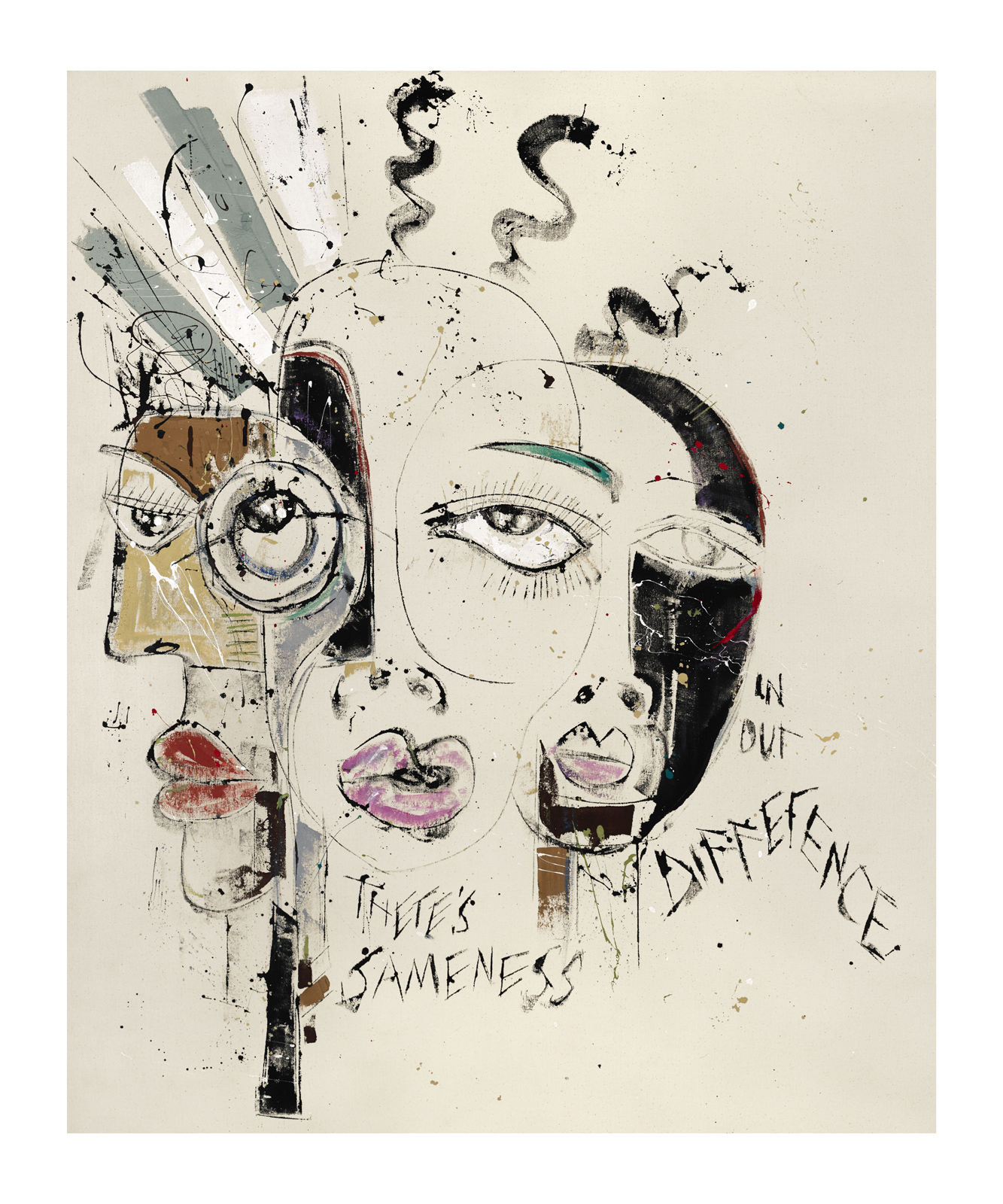
Neo-Expressionism
Regis at his most aggressive and most directly political. Torn strips of printed paper and magazine pages built into crowns and headdresses. Heavy black line work on faces that stare straight out of the canvas. Spray paint, splatter, hot neon pinks and oranges smashed against deep reds and blacks. Text painted in large capitals — demands, declarations, protest slogans — functioning as marks first and language second. The "America" painting of the George Floyd protests is the most explicitly documentary work in the collection, but even the confrontational pieces maintain what his gallery describes as "aggressively hopeful." The formal vocabulary connects to Basquiat's raw surfaces and symbolic figuration, but Regis is more legible, more emotionally open, and more willing to let tenderness sit alongside fury on the same canvas.
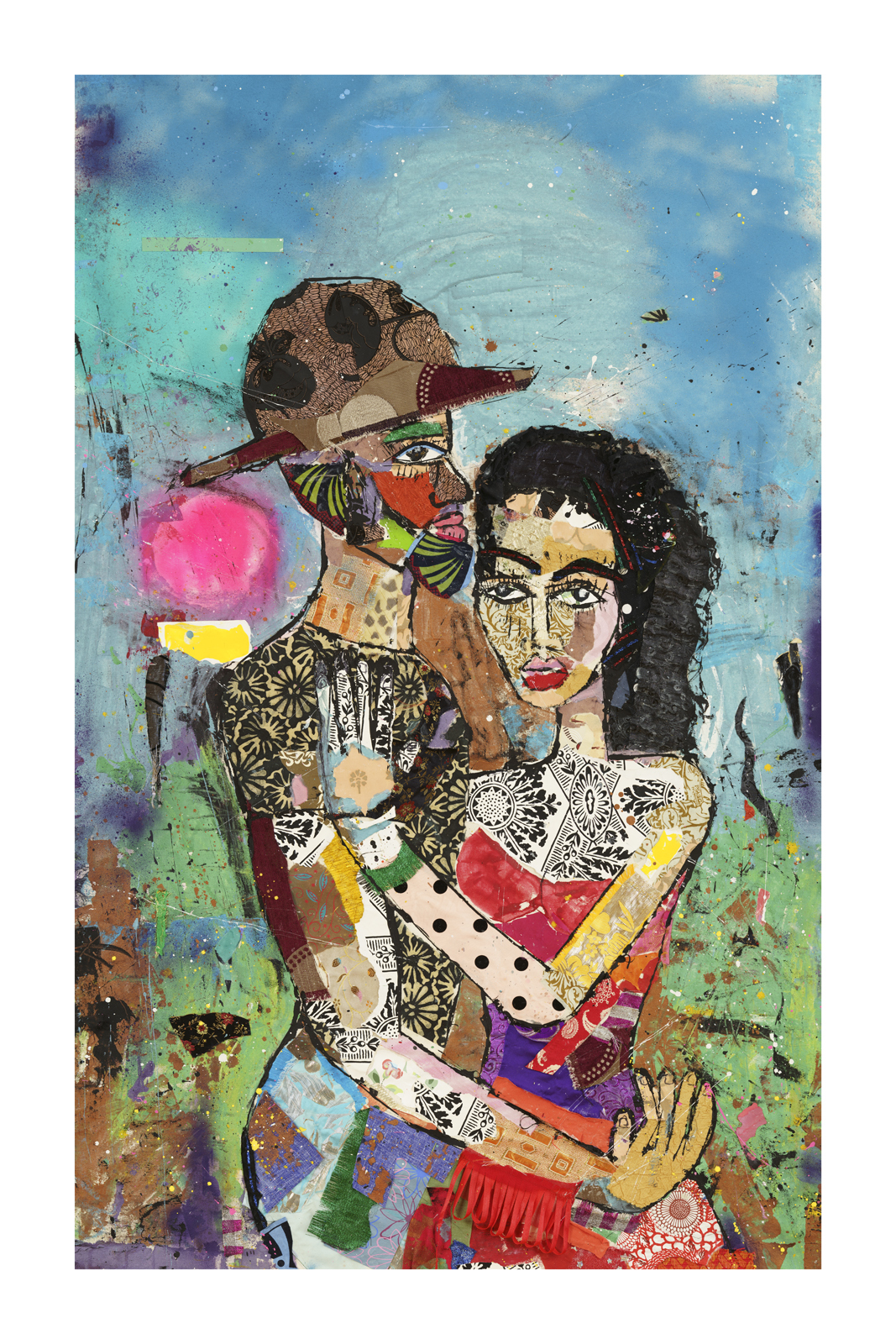
Collage Work
Different materials, different emotional register. The collage paintings build figures almost entirely from found textiles — patterned fabrics, lace, printed cottons, decorative papers — layered and assembled into compositions that are warm, tactile, and densely constructed. A woman's dress is made from the same fabric scraps that form her skin; a man's hat is a patchwork of printed cloth. The technique owes as much to Romare Bearden's cut-paper Harlem scenes as it does to Regis's parallel career in fashion design — he's spent years working with textiles, and the collage paintings are where that knowledge becomes visible. The palette runs warmer than the Neo-Expressionist work. The subjects tend toward intimacy — couples, embraces, faces in close proximity. Where the Neo-Expressionism confronts, the collage work invites.
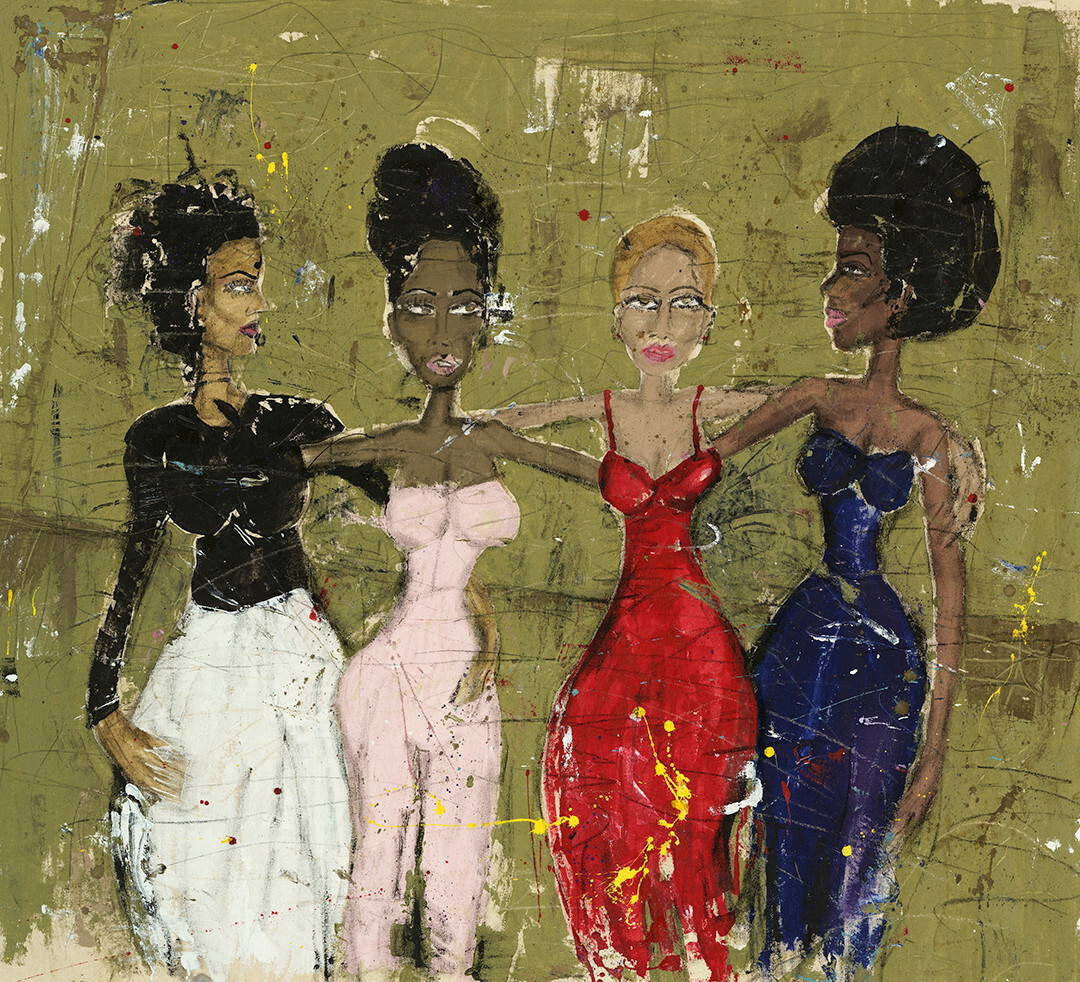
Portraiture
The most pared-back of the three modes. Families, groups of women, domestic scenes — rendered in scraped and scratched paint on worked-over surfaces. The palette drops to earth tones, olives, muted pinks, blacks. The figures are loosely drawn but fully inhabited: a family on a couch, the mother's gaze direct and unwavering; four women standing shoulder to shoulder in block-color dresses against a chartreuse ground. The scratching and scraping into the paint surface keeps the domestic subjects from reading as sentimental. These paintings sit closer to the contemporary Black figurative tradition — the territory of Henry Taylor and Lynette Yiadom-Boakye — than to Neo-Expressionism. Quieter than the other two bodies of work, but no less specific about who these people are and how they occupy space together.